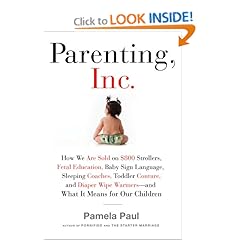
I've been reading Parenting Inc by Pamela Paul
I highly recommend it for anyone involved with children, not just parents. It's basically a great understanding of why parent are major marketing target, what the media and marketing firms have done over the years to make us believe that we need all of these products to keep our kids "safe & healthy" - when in fact most of it isn't safe or healthy. They feed on our fear. Which is how most of the collective consciousness, at least in the US, is. Anyone who reads this book will definitely question why we do what we do & how to finally change that & not just when it comes to parenting.
From my own life: I really strive to live simply, and when I announced that I would not have a crib or stroller, or a host of other items my family was so willy to buy me, they really got puzzled, why wouldn't I want the "best" for my child. Eventually it all crept in, we've had 4 strollers, now 2, a walker, tried every carrier there is out there, 4 diaper bags, clothes and toys (way tooo many), 4 high/booster chairs. And so lately I've been letting it go. I've put away about 95% of J's toys, and relish in the fact that he enjoys playing with pots and Tupperware more than his toys. Yes even the most well meaning of us can get trapped under this mound of baby things. Most of which was gifted to us, but there are still items that we have bought that I've either returned or thought "did I really need that". I've been really paying attention these days, and then came across this book. I plan on gifting it to friends and family & making requests for J's 2nd birthday, to keep it simple.
My intention is to provide a life rich with experiences for my son, as opposed to rich with material things. And I thank this book for reminding me of that. Intimacy is much more rewarding that interaction with things.
here is a review:
From Publishers Weekly: Paul, mother of two, probes the business of parenting, exposing the high price of raising kids in our consumer-driven nation. Paul points out that it costs upwards of a million dollars to raise a child in the U.S. these days, especially if one buys into the theory that baby must have everything on the market. Following the money, Paul dissects the booming baby business, including smart toys that don't really make kids smarter, themed baby showers and parenting coaches and consultants. The text is a tireless rundown of parents' seemingly bottomless pocketbooks when it comes to bringing up baby, and according to Paul this is not just an upscale, cosmopolitan phenomenon—throughout the country parents are reaching deep into their pockets to fuel this spiraling craze. Though Paul incorporates the pithy quotes of a number of experts, such as psychologist David Elkind's observation, Computers are part of our environment, but so are microwaves and we don't put them in cribs, readers may find themselves wishing for more commentary and less litany. But Paul isn't preachy, although she does reveal that what babies really need is holding, singing, dancing, conversation and outdoor play. (Apr.) Copyright © Reed Business Information, a division of Reed Elsevier Inc. All rights reserved.


No comments:
Post a Comment